

Can We Draw A Reb Black Tree With With 7 Black Nodes And 10 Red Nodes
| Data Structures and Algorithms |
| 8.two Red-Blackness Trees |
A red-black tree is a binary search tree with one extra aspect for each node: the colour, which is either red or black. Nosotros also demand to go along rail of the parent of each node, and so that a scarlet-blackness tree's node structure would be:
struct t_red_black_node { enum { reddish, black } color; void *item; struct t_red_black_node *left, *right, *parent; } For the purpose of this discussion, the NULL nodes which cease the tree are considered to be the leaves and are coloured black. Definition of a ruby-red-black tree
A red-black tree is a binary search tree which has the following red-black backdrop:
|
|
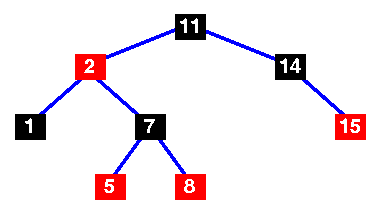 | A basic ruby-red-black tree |
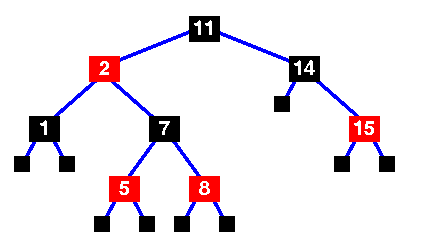 | Basic red-black tree with the sentinel nodes added. Implementations of the red-black tree algorithms volition usually include the sentinel nodes equally a convenient means of flagging that you have reached a leaf node. They are the Nix black nodes of property 2. |
Lemma
A red-blackness tree with n internal nodes has summit at most 2log(due north+one).(For a proof, see Cormen, p 264)
This demonstrates why the red-black tree is a expert search tree: it tin can always be searched in O(log n) time.
As with heaps, additions and deletions from red-black trees destroy the red-black property, so we demand to restore information technology. To do this we need to await at some operations on cherry-blackness copse.
Rotations
| A rotation is a local performance in a search tree that preserves in-order traversal key ordering. Note that in both trees, an in-order traversal yields: A ten B y C | 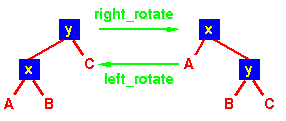 |
left_rotate( Tree T, node 10 ) { node y; y = x->right; /* Turn y's left sub-tree into ten's right sub-tree */ x->right = y->left; if ( y->left != NULL ) y->left->parent = 10; /* y'southward new parent was x's parent */ y->parent = x->parent; /* Set the parent to point to y instead of 10 */ /* First run into whether we're at the root */ if ( x->parent == Cipher ) T->root = y; else if ( 10 == (x->parent)->left ) /* x was on the left of its parent */ x->parent->left = y; else /* x must have been on the right */ 10->parent->right = y; /* Finally, put x on y'southward left */ y->left = x; x->parent = y; } Insertion
Insertion is somewhat circuitous and involves a number of cases. Notation that we start by inserting the new node, ten, in the tree but every bit we would for any other binary tree, using the tree_insert role. This new node is labelled red, and possibly destroys the red-black property. The main loop moves upwards the tree, restoring the red-blackness property.rb_insert( Tree T, node x ) { /* Insert in the tree in the usual way */ tree_insert( T, x ); /* Now restore the red-black property */ ten->color = red; while ( (ten != T->root) && (x->parent->color == red) ) { if ( ten->parent == x->parent->parent->left ) { /* If x'south parent is a left, y is x'southward right 'uncle' */ y = x->parent->parent->right; if ( y->colour == red ) { /* case ane - change the colours */ ten->parent->color = blackness; y->colour = black; ten->parent->parent->color = red; /* Move 10 up the tree */ ten = x->parent->parent; } else { /* y is a black node */ if ( x == x->parent->right ) { /* and x is to the correct */ /* example ii - motility x up and rotate */ x = x->parent; left_rotate( T, x ); } /* case 3 */ x->parent->color = blackness; x->parent->parent->colour = red; right_rotate( T, x->parent->parent ); } } else { /* repeat the "if" office with right and left exchanged */ } } /* Colour the root black */ T->root->colour = black; } Hither's an example of the insertion operation.
Animation
| Cherry-red-Black Tree Animation This animation was written by Linda Luo, Mervyn Ng, Anita Lee, John Morris and Woi Ang. | Please e-mail comments to: |
Examination of the lawmaking reveals only one loop. In that loop, the node at the root of the sub-tree whose reddish-black property nosotros are trying to restore, x, may exist moved up the tree at least i level in each iteration of the loop. Since the tree originally has O(log due north) top, there are O(log n) iterations. The tree_insert routine also has O(log northward) complexity, so overall the rb_insert routine also has O(log northward) complication.
Key terms
- Red-black trees
- Trees which remain counterbalanced - and thus guarantee O(logn) search times - in a dynamic surround. Or more importantly, since any tree can be re-balanced - but at considerable cost - can exist re-balanced in O(logn) time.
© , 1998

Can We Draw A Reb Black Tree With With 7 Black Nodes And 10 Red Nodes,
Source: https://www.cs.auckland.ac.nz/software/AlgAnim/red_black.html
Posted by: morriswitts1986.blogspot.com
0 Response to "Can We Draw A Reb Black Tree With With 7 Black Nodes And 10 Red Nodes"
Post a Comment